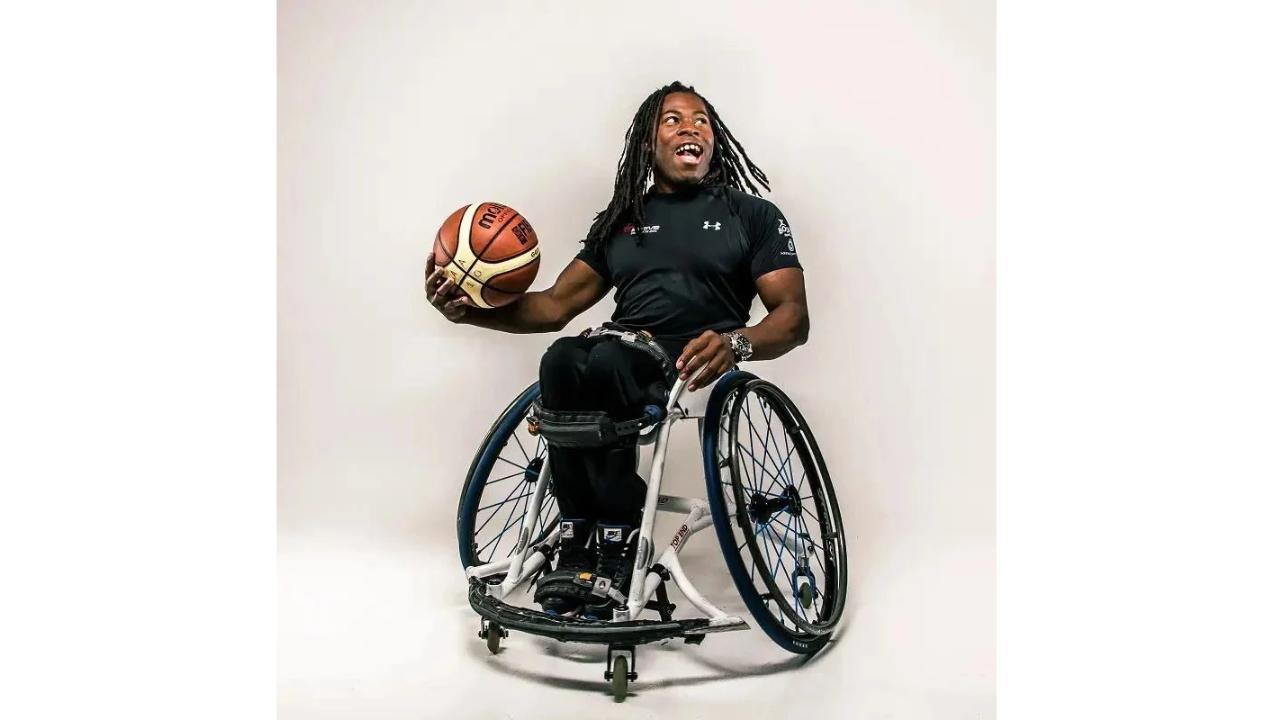
Ade Adepitan uses a wheelchair because he contracted polio at 15 months old, leaving him with permanent paralysis in his left leg and limited movement in his right leg. The British Paralympian contracted the disease while living in Lagos, Nigeria, shortly before receiving his final scheduled polio vaccination. His family subsequently moved to Britain, where he received medical support before discovering wheelchair basketball. His childhood experiences gained renewed attention following his appearance on I’m a Celebrity… Get Me Out of Here! in November 2026.
Why Is Ade Adepitan in a Wheelchair?
Ade Adepitan relies on a wheelchair because of permanent physical damage caused by poliomyelitis during infancy.
Polio is an infectious disease that can attack the nervous system, particularly the motor neurons responsible for controlling muscle movement. In severe cases, the infection causes irreversible paralysis.
For Adepitan, the illness affected both legs, significantly restricting his ability to walk without assistance.
Although he can use crutches for certain activities, a wheelchair remains his primary mobility aid, allowing him to travel, work and maintain an active lifestyle.
Contracting Polio
Born on March 27, 1973, in Lagos, Nigeria, Adepitan experienced serious health complications before reaching his second birthday.
He contracted polio when he was just 15 months old, despite having already received two doses of the vaccine.
According to his account, he became infected only days before he was scheduled to receive his third vaccination.
The disease spread through his nervous system, damaging the nerves responsible for controlling movement in his lower limbs.
At the time, Nigeria faced considerable challenges in controlling poliovirus transmission, and childhood infections could have devastating long-term consequences.
His diagnosis prompted his parents to reconsider where their family could access appropriate medical treatment.
How Polio Affected His Legs
The infection left Adepitan with permanent mobility difficulties that continued throughout his childhood and adulthood.
His left leg became completely paralysed, while his right leg retained partial movement.
This difference in muscle function meant that standing and walking required additional physical support.
Although rehabilitation and mobility equipment helped him manage everyday activities, they could not reverse the neurological damage caused by the infection.
His current mobility needs are therefore the result of lasting complications from childhood polio rather than an active infection.
Moving to Britain
Adepitan’s parents, Ajibola Olusola and Christianah Adejoke, decided to relocate to Britain to improve their son’s healthcare prospects.
His father travelled to London first, while Ade and his mother joined him in 1976.
Adepitan was three years old when he settled in East London.
Growing up in Britain gave him access to medical assistance, rehabilitation and educational opportunities.
However, adjusting to life with restricted mobility remained challenging, particularly during his early school years when accessibility was less developed than it is today.
Walking With Leg Braces
Before becoming a regular wheelchair user, Adepitan relied on heavy metal leg braces known as callipers.
These devices supported his legs and helped him remain upright while using crutches.
Walking with such equipment required considerable physical effort, making ordinary journeys more demanding.
The braces were an important part of his childhood mobility, but they offered less flexibility than a wheelchair.
As he grew older, he began exploring alternative ways to move around independently and participate in recreational activities.
Using a Wheelchair
At approximately 12 years old, Adepitan began relying more heavily on a wheelchair.
The transition allowed him to move more efficiently while reducing the physical demands associated with walking using metal braces and crutches.
It also introduced him to sporting opportunities that had previously been difficult to access.
Rather than preventing him from participating in physical activities, his wheelchair enabled him to develop new skills, compete against other athletes and establish greater independence.
Wheelchair basketball soon became a central part of his life.
Paralympic Achievement
Adepitan pursued wheelchair basketball seriously during his teenage years, eventually leaving home at 17 to concentrate on his sporting ambitions.
His commitment earned him opportunities to represent Great Britain in international competitions.
He won a bronze medal at the 2004 Athens Paralympic Games as a member of Britain’s wheelchair basketball team.
He subsequently helped Britain secure gold at the 2005 Paralympic World Cup in Manchester.
His achievements demonstrated how adaptive sports and appropriate mobility equipment can provide opportunities for athletes with permanent physical disabilities.
In 2005, he received an MBE for his services to disability sport.
I’m a Celebrity 2026
Adepitan’s medical history became a prominent discussion topic following his November 2026 appearance on I’m a Celebrity… Get Me Out of Here!
He reportedly became the programme’s first wheelchair-using contestant, bringing greater visibility to disability representation in mainstream reality television.
During conversations with fellow contestants, he explained how contracting polio during infancy affected his childhood and described his experiences of using mobility aids.
His participation also encouraged wider discussions about accessibility and how television productions can accommodate contestants with different physical requirements.
Can Ade Adepitan Walk?
Ade Adepitan retains limited movement in his right leg and can use crutches in certain circumstances. However, he cannot walk normally without assistance because of the permanent nerve damage caused by polio.
His wheelchair provides reliable mobility and supports his demanding professional schedule.
Today, Adepitan continues his work as a broadcaster, documentary presenter and disability advocate. His experiences highlight the importance of childhood vaccination, accessible environments and equal opportunities for people living with physical disabilities.